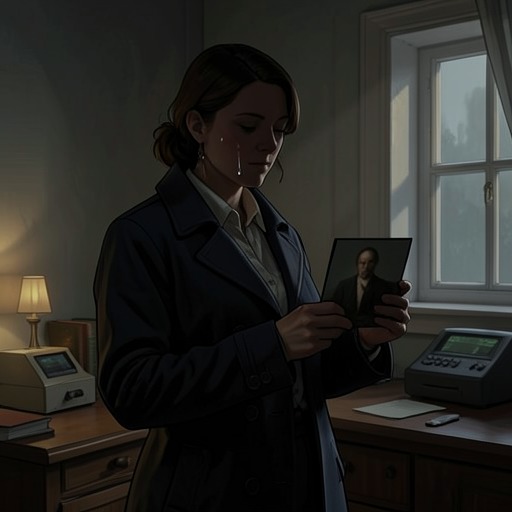
Elizabeth Zott’s grief and depression
Lessons in ChemistryElizabeth Zott’s grief and depression are shown not as a single episode of mourning but as a burden that reshapes how she understands her past and limits her ability to continue her work. After years of responding to hardship by pressing on, she finds herself unable to recover from Life magazine’s distortion of her identity. Her loss becomes visible in her abandoned laboratory and in Harriet Sloane’s uncertainty about whether Elizabeth will regain her footing.
Loss and Self-Blame
In speaking with Roth, Elizabeth assigns herself complete responsibility for Calvin Evans’s death. She recounts the accident, the leash, and the sirens, and connects that loss to a vow never again to hold anyone back. Her account makes grief inseparable from a continuing judgment of her own choices: she does not describe Calvin’s death as an isolated tragedy, but as the beginning of a chain of failures.
The failures she names reach into several parts of her life. After Dr. Donatti stole her research, she gave up her scientific work. Wanting Madeline Zott to fit in, she enrolled her in a school where Madeline did not fit in. Elizabeth also condemns herself for becoming the kind of performer she least wanted to resemble, like her father. These are Elizabeth’s own connections between loss and later events, rather than proof that Calvin’s death caused each outcome. Their accumulation shows how thoroughly grief has become a framework through which she judges her decisions.
Even in this account, her self-blame has a boundary. She includes Phil Lebensmal’s heart attack among the events that followed, but explicitly refuses to count it as a failure. The qualification complicates her sweeping claim of responsibility: Elizabeth can catalogue consequences harshly without treating every consequence as something she regrets. Her conversation with Roth gives a listener access to the scale of her guilt, while Roth’s reaction also turns attention toward the ease with which people discount their own circumstances and the losses they carry.
The Article and the Failure of Endurance
For several weeks, Elizabeth tries to ignore the Life magazine article and continue her daily routines. She prepares lunch-box notes for Madeline, closes the lunch box, and busies herself at a Bunsen burner. In the past, continuing through one difficulty after another had helped her survive suicide, sexual assault, lies, theft, and catastrophic loss. This time, however, her effort to carry on does not protect her from the article’s effects. Its misrepresentation of her feels permanent to her, and she cannot simply outlast it.
The reversal is significant because the article attacks more than her public reputation. Its damage reaches the identity she has worked to sustain as a scientist. When Harriet Sloane tries to draw her attention to letters and an unpublished scientific piece by Roth, Elizabeth refuses to engage and snaps that she is not interested. Harriet’s attempt to redirect her toward the work of other women scientists does not immediately break through. Elizabeth’s declaration that her life is over marks how completely the article has narrowed her sense of what remains possible; the evidence presents that despair as her state of mind, not as a settled account of her future.
The Laboratory and the Household
The laboratory makes Elizabeth’s depression observable in concrete absences. Harriet Sloane sees empty research notebooks, chemical supplies left untouched, and pencils that have not been sharpened. These are the tools of Elizabeth’s scientific life, still present but no longer in use. The contrast between the familiar workspace and its inactivity gives physical form to the research she has abandoned and to the difficulty of resuming it.
Other routines persist, but they do not erase the change. Elizabeth continues to prepare Madeline’s lunch and has baked muffins for breakfast. After Elizabeth leaves, Harriet opens the lunch box and finds a bleak note addressed to Madeline. The ordinary acts of feeding and caring for her daughter coexist with a private despair that Harriet is only beginning to recognize in its full extent. Madeline tells Harriet that she is worried about her mother. Their concern establishes that Elizabeth’s suffering is no longer visible only through her own withdrawal; it has become a fear shared within the household.
Harriet’s Concern and an Unresolved Ending
Harriet reassures Madeline that Elizabeth will recover soon, but privately she is not sure. She fears Elizabeth may have reached her breaking point. The gap between Harriet’s reassurance and her private uncertainty captures the limits of what either Harriet or Madeline can know at this moment: care can offer company and hope, but it cannot guarantee that Elizabeth will quickly return to herself.
Harriet also recognizes her own connection to the crisis. She was the person who persuaded Elizabeth to agree to the Life interview, and she sees that the article’s damage was compounded by fraudulent quotations attributed to Dr. Donatti and Dr. Meyers. Her guilt does not displace Elizabeth’s depression, but it gives Harriet a personal stake in its aftermath. The article that was supposed to present Elizabeth to readers has instead helped make her feel that her life and work have been taken from her.
The episode leaves recovery open. Elizabeth’s practiced endurance has failed against this particular injury, and the evidence offers no quick change of heart or return to research. Instead, the signs are a closed lunch box, an idle laboratory, a daughter’s worry, and Harriet’s fear. Together they distinguish grief from a momentary sadness: it has begun to interrupt work, alter Elizabeth’s sense of her future, and unsettle the people closest to her.